
Rs.10,000
Section 248(2) · Form STK-2 · C-PACE
Company Strike Off - A Clean, Final Exit
Closed by Chartered Accountants. Not abandoned.
Not every company is meant to run forever. STK-2 through C-PACE closes yours properly - liabilities settled, pending returns cleared, directors protected - so the ending doesn't follow you into your next venture.
- Eligibility, Section 249 bars and pending annual filings screened first
- STK-3, STK-4 and STK-8 pack prepared before C-PACE filing
- STK-6 objection window and STK-7 dissolution tracked to closure
75%
member consent by paid-up capital required
30
days the public notice stays open for objections
4-8
months from filing to dissolution, realistically
Exit check
Can your company be struck off?
STK-2 is available only after liabilities, annual filings, bank accounts, member consent and recent Section 249 events are checked.
Eligible to exit
No business within one year or no business for two financial years can fit Section 248(2).
Clear filings first
AOC-4 and MGT-7 up to the year operations ceased must be filed before STK-2.
Settle the balance sheet
Liabilities, charges, bank accounts and regulatory NOCs must close before C-PACE accepts the file.
Watch the 3-month bar
Recent name, office or property changes can block strike off under Section 249.
ROC filing desk
Company Strike Off Services in India
Strike off is the Companies Act's orderly exit for a company that never took off or has stopped trading - an STK-2 application to C-PACE under Section 248(2), backed by a Rs.10,000 fee, director affidavits, and accounts certified within the last 30 days. Done right, it ends in an STK-7 dissolution notice and a clean record. Done casually, it bounces - usually on the annual filings nobody cleared first.
What strike off is - and what it is not
Company strike off is the removal of a company's name from the Register of Companies under Section 248 of the Companies Act, 2013 - voluntarily through Form STK-2 to C-PACE, or involuntarily by the Registrar for prolonged non-filing.
It is not liquidation, not an amnesty, and not an escape from pending AOC-4 or MGT-7 filings. Section 248(7) keeps directors liable for past obligations, and unsatisfied charges, active prosecution or a Section 249 bar can stop the application before the 30-day objection window even begins.
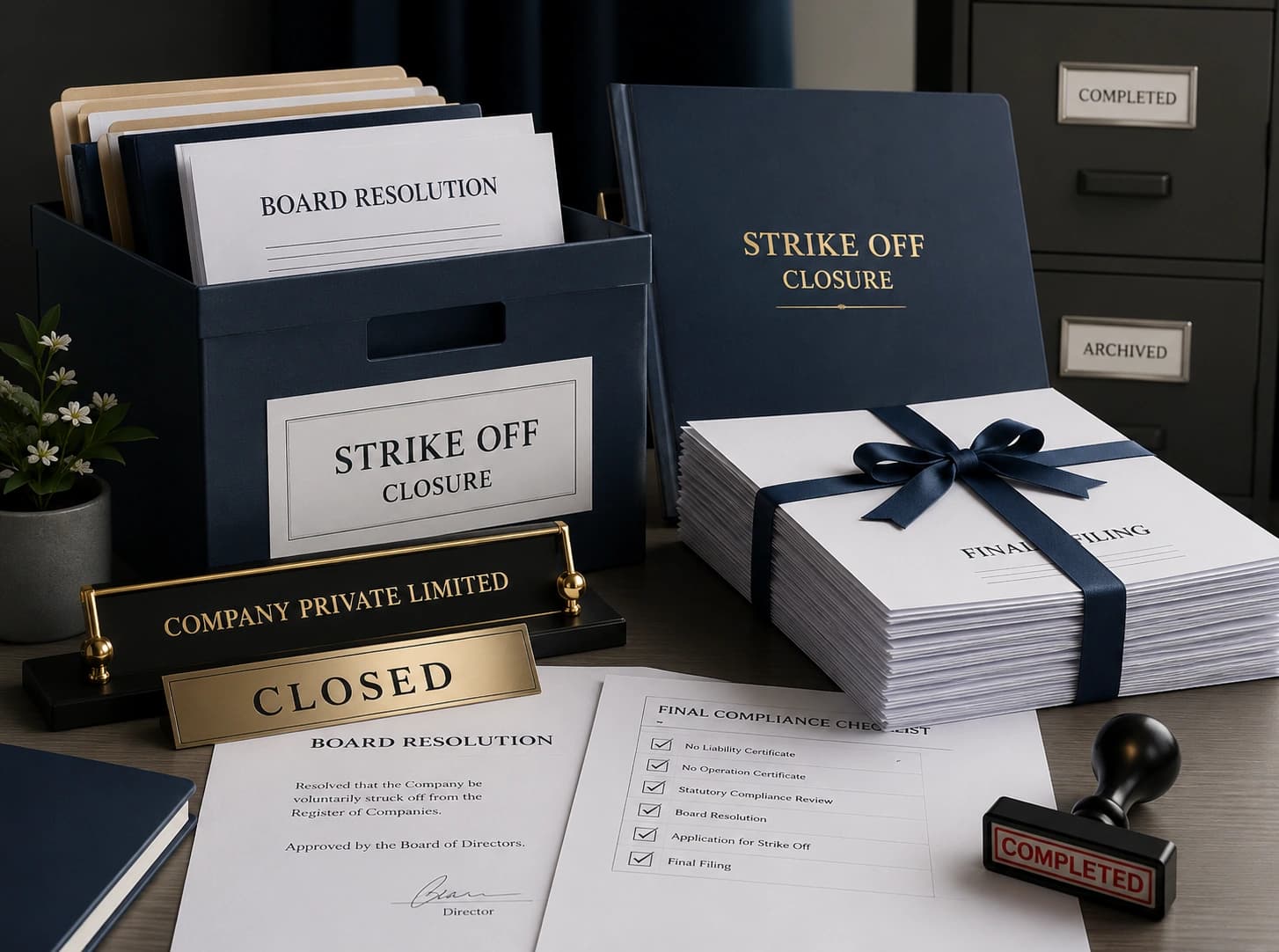
Decision table
Strike off, dormancy, or winding up?
The right exit depends on activity, liabilities, cost, timeline and whether the company may need revival later.
| Factor | Strike off | Dormancy | RecommendedWinding up |
|---|---|---|---|
| Who it suits | No business or stopped trading | Company to keep for future use | Companies with complex liabilities |
| Cost order | Rs.10,000 STK-2 fee plus prep | Lower annual maintenance | Higher legal and professional cost |
| Timeline | 4-8 months | Weeks for dormant status | Months to years |
| Liabilities | Must be extinguished first | Company continues to exist | Settled through process |
| Revival | NCLT route under Section 252 | Company remains alive | Depends on winding-up stage |
← Scroll →
Every ROC answer changes once dates, DIN status, and MCA V3 master data are checked. We confirm the route before a form reaches certification.
Check your filing routeFiling sequence
From decision to dissolution
A clean exit moves through eligibility, pending forms, director declarations, C-PACE scrutiny and public notice before STK-7.
- 1
Section 249 screening
Step 1Recent changes, charges, litigation and activity status are checked before STK-2.
- 2
Annual filings cleared
Step 2Pending AOC-4 and MGT-7 are filed up to the year operations ceased.
- 3
Liabilities settled
Step 3Bank accounts, dues, NOCs and charges are closed before the exit pack is signed.
- 4
Member consent
Step 4Board approval and 75% member consent or special resolution are documented.
- 5
STK pack prepared
Step 5STK-3, STK-4 and STK-8 accounts not older than 30 days are finalized.
- 6
STK-2 filed
Step 6C-PACE scrutiny is handled with the Rs.10,000 government fee.
- 7
Dissolution notice
Step 7STK-6 public notice, 30-day objection window and STK-7 dissolution are tracked.
Where it breaks
Why STK-2 applications bounce
Strike off rejections usually come from stale accounts, unresolved filings, charges or recent prohibited changes.
The risk
Pending annual returns
AOC-4 and MGT-7 were never cleared up to the year operations stopped.
How we handle it
We file pending annual forms before STK-2.
The risk
Old STK-8 accounts
The statement of accounts is older than 30 days on the filing date.
How we handle it
We time CA certification close to submission.
The risk
Unsatisfied charge
A loan charge remains open on MCA records.
How we handle it
We check and close charge status before the exit.
The risk
3-month bar
A recent office change or property disposal blocks Section 248(2).
How we handle it
We screen Section 249 before drafting the pack.
Registry risk
Abandoning is not closing
A company left to rot still files, still accrues Rs.100 a day per overdue form, and still drags its directors toward Section 164 disqualification - until the ROC strikes it off involuntarily on its own terms, not yours. Voluntary strike off costs Rs.10,000 and a few months of paperwork. Abandonment costs more and ends worse. Choose the ending.
Annual retainer
Strike off pricing by readiness
Ready company
From Rs.X,XXX
No liabilities, filings current, STK-8 ready within 30 days.
Pending filings
Custom
AOC-4/MGT-7 cleanup before STK-2.
Complex exit
Custom
Charges, NOCs, notices or Section 249 timing issues.
Managed desk
Exits are where shortcuts surface
Pre-condition order
Annual filings, bank closure, charges and NOCs are cleared before STK-2.
Fresh documents
STK-8 accounts are filed within the 30-day freshness window.
C-PACE handling
Objections and resubmissions are handled through the centralized exit process.
Final proof
STK-7 dissolution notice is tracked, not assumed.
Who this fits
Endings we handle weekly
Pivoted startup
A new entity is active; the old company needs STK-2 closure.
Shelf company
Business never commenced within one year of incorporation.
Family company
Promoters moved abroad and want the register cleaned.
248(1) notice case
Company wants voluntary control before involuntary strike off.
Related
Next ROC filings to check
AOC-4, MGT-7, DIR-3 KYC and event filings often move together once the annual calendar starts.
STK-2 should not become a notice
Share the company name, DIN status or AGM date. A CA-led desk will map the filing route and send the next action before the meter starts.
MCA V3 filing, certification support, challan archive.